
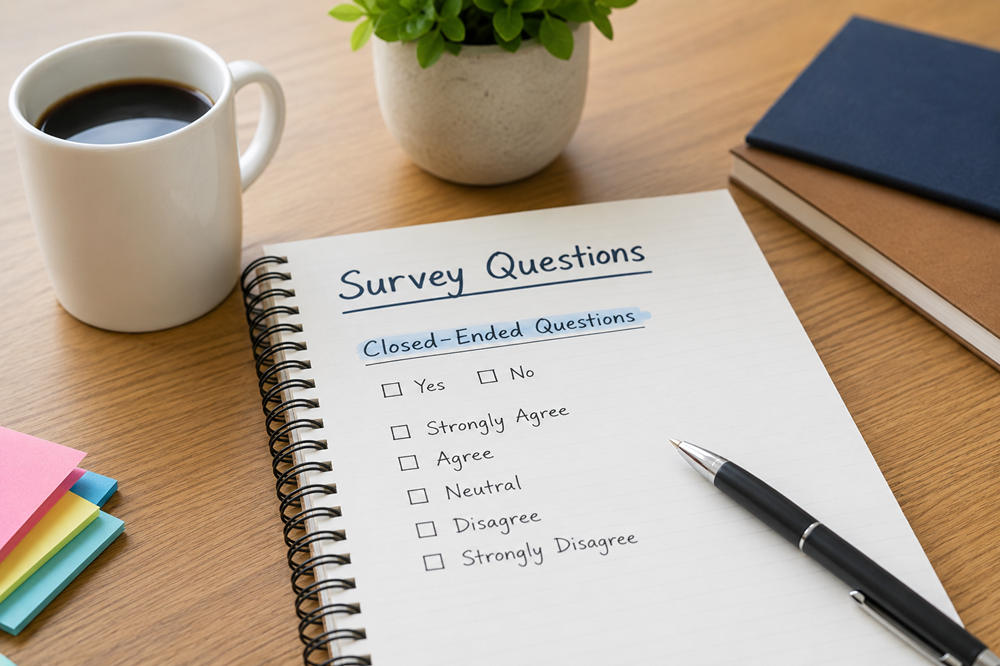
100 Closed-Ended Question Examples for Surveys, Interviews, and Everyday Use
Closed-ended questions help collect clear, structured information. They can confirm a fact, identify a preference, measure an opinion, or place a response into a defined category.
The term is sometimes written as close-ended questions, although closed-ended questions is more common in survey research. These questions can use yes-or-no responses, multiple-choice selections, rating scales, checklists, frequency ranges, or rankings.
The examples below include question prompts only. When using them in an actual questionnaire, add response choices that are clear, relevant, and appropriate for the people being surveyed. The wording and order of survey response options can influence the answers people select.
What Is a Closed-Ended Question?
A closed-ended question asks someone to respond using a limited set of choices. Instead of writing an unrestricted answer, the respondent selects an option, supplies a rating, confirms a fact, or chooses from a defined range.
For example, a closed-ended question might ask whether someone has visited a location, which service plan they use, or how satisfied they are on a scale from 1 to 5.
This format is useful when answers need to be counted, sorted, compared, or tracked over time. Closed-ended questions are commonly used in surveys, registration forms, customer feedback questionnaires, interviews, classroom assessments, and workplace evaluations.
Closed-Ended vs. Open-Ended Questions
The main difference is how much freedom the respondent has when answering.
| Feature | Closed-Ended Question | Open-Ended Question |
|---|---|---|
| Response format | Predefined choices or ranges | Response in the person’s own words |
| Typical length | Brief | As detailed as needed |
| Best suited to | Facts, categories, ratings, and measurable behavior | Reasons, stories, explanations, and unexpected ideas |
| Analysis | Responses can usually be counted directly | Responses often need to be reviewed and grouped |
| Time required | Usually quick to complete | Requires more thought and writing |
For example, “How satisfied were you with your purchase on a scale from 1 to 5?” produces a measurable rating. “What did you like or dislike about your purchase?” gives the customer room to explain.
Common Types of Closed-Ended Questions
The right format depends on the information being collected. Each type serves a slightly different purpose.
Yes-or-No Questions
Yes-or-no questions confirm whether a statement or condition is true.
Example: Have you renewed your membership?
Either-Or Questions
Either-or questions ask someone to choose between two alternatives.
Example: Would you prefer a morning or afternoon appointment?
Multiple-Choice Questions
Multiple-choice questions present several defined options and usually allow one selection.
Example: Which device do you use most often?
Checklist Questions
Checklist questions allow respondents to select every listed choice that applies.
Example: Which facilities did you use during your visit?
Rating-Scale Questions
Rating-scale questions measure the level, quality, or intensity of an experience.
Example: How would you rate the cleanliness of the building on a scale from 1 to 5?
Likert-Scale Questions
Likert-scale questions measure how strongly someone agrees or disagrees with a statement.
Example: How strongly do you agree that the instructions were easy to understand?
Frequency Questions
Frequency questions measure how regularly an activity or experience occurs.
Example: How often do you use the shared workspace?
Ranking Questions
Ranking questions ask respondents to arrange several choices according to preference or importance.
Example: How would you rank the listed employee benefits from most to least important?
Partially Closed Questions
A partially closed question provides a list of choices while allowing respondents to select “Other” when none of the listed options fits.
Example: Which communication channel do you prefer?
15 Closed-Ended Questions About Everyday Choices and Preferences
These questions focus on personal tastes and simple decisions. They can be used for informal conversations, audience polls, profile forms, or social activities.
- Do you prefer coffee or tea?
- Are you more productive in the morning or evening?
- Would you rather spend your free time indoors or outdoors?
- Do you usually cook at home or order food?
- Do you prefer printed books, e-books, or audiobooks?
- Would you choose a beach, mountain, city, or countryside vacation?
- Do you enjoy listening to music while working?
- Do you prefer to plan your meals in advance?
- Would you rather shop online or in a physical store?
- Would you prefer to own a dog, cat, bird, fish, or another type of pet?
- Would you choose a smartphone with a larger screen or a smaller body?
- Do you prefer small gatherings or large social events?
- Which of the listed weekend activities appeals to you most?
- Do you prefer sweet or savory snacks?
- Would you rather have a window seat or an aisle seat?
15 Closed-Ended Questions About Personal Facts and Routines
These examples collect factual information about schedules, habits, living arrangements, and regular activities rather than personal preferences.
- Do you usually wake up before 7:00 a.m. on weekdays?
- Which form of transportation do you use most often?
- Do you usually work or study on-site, remotely, or through a hybrid arrangement?
- Do you exercise for at least 30 minutes three or more days a week?
- Do you usually sleep between seven and eight hours a night?
- Do you spend more than four hours a day on recreational screen use?
- Do you prepare a meal from basic ingredients at least three times a week?
- Do you eat breakfast every day?
- Do you regularly use a calendar or planner?
- Do you check the news at least once a day?
- Have you used public transportation during the past seven days?
- Do you live alone or with other people?
- Do you usually shop for groceries once a week?
- Do you spend at least five hours a week on hobbies?
- Do you usually go to bed at approximately the same time each night?
12 Closed-Ended Questions for Customer Feedback
Customer feedback questions can measure separate parts of the buying experience, including checkout, product performance, delivery, support, and future purchasing intentions.
- How easy was it to complete your purchase on a scale from 1 to 5?
- Did the product meet the need for which you purchased it?
- How satisfied are you with your overall experience on a scale from 1 to 5?
- How would you rate the quality of the product on a scale from 1 to 5?
- Did your order arrive within the expected delivery period?
- Was your issue resolved during your most recent support interaction?
- Did you experience a technical problem during checkout?
- How would you rate the product’s value for its price?
- Are you likely to buy from the company again?
- How likely are you to recommend the company on a scale from 0 to 10?
- Which support channel did you use most recently?
- Which of the listed reasons best describes why you contacted customer support?
12 Closed-Ended Questions for Employee Feedback
Employee questions should focus on one workplace issue at a time. These examples address expectations, resources, workload, management, recognition, communication, development, and retention.
- Do you clearly understand what is expected of you in your current role?
- Do you have the resources needed to complete your work effectively?
- Is your current workload manageable?
- Does your manager provide useful feedback at least once a month?
- Have you received recognition for good work during the past three months?
- Is communication within your immediate team effective?
- Do you feel comfortable raising a work-related concern?
- Are suitable professional development opportunities available to you?
- Do your team’s regular meetings help you complete your work?
- Does your current work arrangement provide enough flexibility?
- Are the tools and systems you use reliable?
- Do you expect to remain with the organization for the next 12 months?
12 Closed-Ended Job Interview Questions
Closed-ended interview questions are useful for confirming availability, qualifications, and practical job requirements. They should support broader questions that allow candidates to explain their experience and accomplishments.
Interview questions should remain connected to the position and comply with the laws that apply in the employer’s location. In the United States, employers may generally ask whether a candidate is authorized to work and whether sponsorship will be required. However, they should avoid improper questions about citizenship, disability, health, or other protected information. The Department of Justice’s guidance for employers and the EEOC’s guidance on disability-related inquiries provide further information.
- Are you currently authorized to work in the United States?
- Will you require employment sponsorship now or in the future?
- Are you available to work the schedule listed in the job description?
- Are you willing to travel at the frequency required for this role?
- Do you hold the professional license or certification required for this position?
- Do you have at least three years of directly relevant experience?
- Have you previously supervised employees?
- Have you used the primary software required for this position?
- Would you be available to start within two weeks?
- Are you able to accept the work arrangement stated in the job description?
- Does the listed compensation range meet your expectations?
- Have you completed the education or training required for the role?
12 Closed-Ended Questions for Students and Classrooms
Classroom questions can help teachers check understanding, identify learning conditions, and adjust the pace or format of a lesson.
- Do you understand the main concept covered in today’s lesson?
- Did you submit the most recent assignment?
- Which of the listed lesson formats helps you concentrate best?
- Do you ask for help when you do not understand something?
- Did you spend at least three hours preparing for the most recent test?
- Do you have regular access to a quiet place where you can study?
- How confident are you that you can apply this skill on a scale from 1 to 5?
- Do you feel comfortable participating in small-group activities?
- How difficult was the latest homework assignment on a scale from 1 to 5?
- Was the pace of today’s lesson too slow, about right, or too fast?
- Which type of academic support have you used most often this term?
- Would a review session before the next test be helpful?
12 Closed-Ended Questions for Market and Product Research
Market research questions examine brand awareness, buying behavior, budgets, feature priorities, and interest in potential products.
- Had you heard of this brand before today?
- Do you purchase products in this category at least once a month?
- Which of the listed brands have you used during the past year?
- Do you usually buy this type of product online or in a physical store?
- Which of the listed price ranges would you consider reasonable for this product?
- How would you rank the listed product features from most to least important?
- Which of the listed problems have you experienced with products in this category?
- How likely are you to switch from your current brand on a scale from 1 to 5?
- Would you be interested in trying a free product sample?
- Would you prefer a one-time purchase or a subscription?
- Which of the listed package sizes would you be most likely to buy?
- Are you the primary decision-maker when purchasing this type of product?
10 Closed-Ended Questions for Events and Registration Forms
Event forms need practical information that organizers can use to plan attendance, meals, sessions, transportation, accessibility, and communication.
- Will you attend the event?
- How many guests will attend with you?
- Which of the listed meals would you prefer?
- Do you have any dietary requirements?
- Which event session would you like to attend?
- Which form of transportation will you use to reach the venue?
- Do you require an accessibility arrangement to participate fully?
- Would you prefer to receive event updates by email, text message, or through the event app?
- Have you attended this event before?
- How satisfied were you with the event on a scale from 1 to 5?
Choosing Between Closed-Ended and Open-Ended Questions
Use a closed-ended question when the response needs to fit a known category, be compared with other answers, or support a specific decision.
This format is particularly useful when you need to:
- Confirm attendance, availability, eligibility, or another fact.
- Measure satisfaction, confidence, agreement, or frequency.
- Identify the most common choice among several possibilities.
- Compare responses across groups or periods.
- Direct a respondent to a relevant follow-up question.
- Keep a questionnaire quick to complete.
An open-ended question is more useful when the respondent’s explanation is the main source of value. It can uncover personal experiences, unusual problems, reasons behind decisions, or ideas that were not anticipated when the questionnaire was created.
The two formats can also be combined. A customer might first rate a service using a closed-ended scale and then receive an optional open-ended field asking for the main reason behind that rating. The first question produces a measurable result, while the second provides context.
Conclusion
Closed-ended questions can collect much more than simple yes-or-no responses. Multiple-choice questions, checklists, ratings, frequency scales, rankings, and partially closed formats can all produce focused information that is easier to organize and compare.
The best format depends on how the response will be used. Choose a closed-ended question when the likely responses are known and need to be measured. Use an open-ended question when the respondent’s reasons, experiences, or unexpected ideas matter most.