
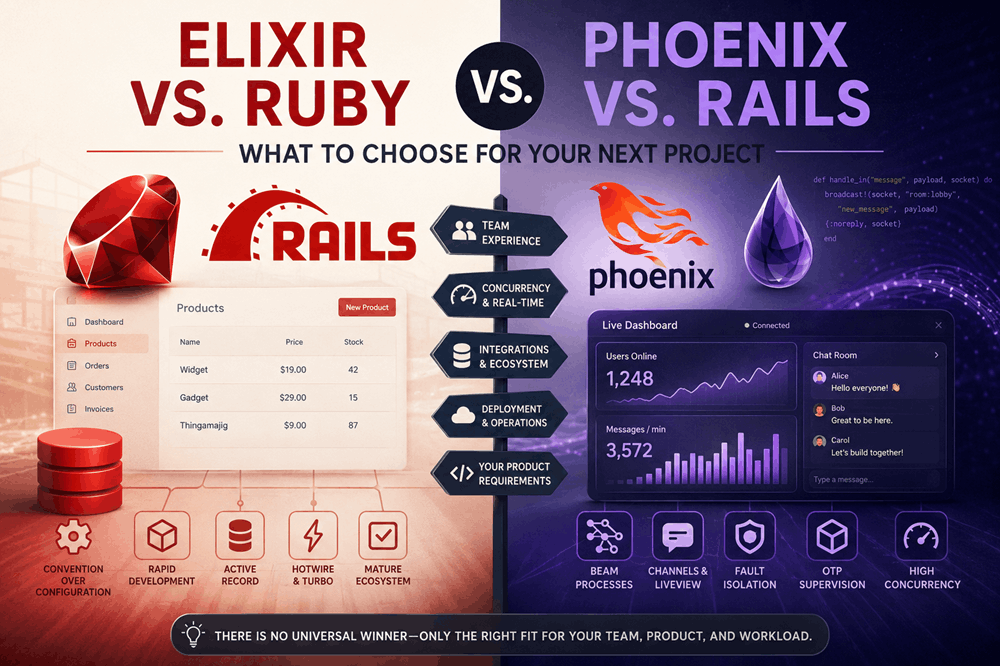
Elixir vs. Ruby and Phoenix vs. Rails: What to Choose
Choosing between Ruby on Rails and Elixir with Phoenix is not simply a contest over speed.
The better stack depends on:
- The product’s main workload
- Expected concurrency
- Real-time requirements
- Necessary integrations
- Team experience
- Hiring options
- Deployment and maintenance needs
Rails is often the safer choice for rapidly building conventional database-backed products with mature integrations and familiar web-development patterns.
Phoenix becomes especially compelling when the application depends on many simultaneous connections, continuously changing server-side state, isolated processes, or fault-tolerant background activity.
Neither framework is universally better.
Elixir vs. Ruby Is Not Phoenix vs. Rails
The title contains two related decisions.
Elixir vs. Ruby
This compares programming languages and runtime models.
Ruby is an expressive, primarily object-oriented language known for readable syntax and developer productivity.
Elixir is a functional language running on the Erlang virtual machine, usually called the BEAM. It emphasizes immutable data, pattern matching, lightweight processes, message passing, and supervision.
Phoenix vs. Rails
This compares web frameworks.
Ruby on Rails is a full-stack framework built around Model–View–Controller conventions, Active Record, routing, views, email, file storage, background jobs, WebSockets, testing, and other common application needs.
Phoenix supports traditional web applications, APIs, real-time communication through Channels, and interactive server-rendered interfaces through LiveView.
A team can use either language without its best-known web framework. The language decision and the framework decision should therefore be evaluated separately.
The Current State of Both Stacks
As of July 2026, the relevant stable feature lines are:
- Ruby 4.0
- Rails 8.1
- Elixir 1.20
- Phoenix 1.8
- Phoenix LiveView 1.2
Ruby 4.0 introduced the experimental Ruby Box isolation feature and an experimental next-generation JIT called ZJIT, alongside other runtime and language improvements. These features demonstrate continued work on Ruby’s runtime, but their experimental status means they should not be treated as the main reason to select Ruby for a production application.
Rails 8.0 added or standardized features including an authentication generator, Kamal 2, Thruster, Solid Cable, Solid Cache, Solid Queue, and Propshaft. Rails 8.1 added Active Job continuations, structured event reporting, local CI, and registry-free Kamal deployments.
Elixir 1.20 completed the first major development milestone of its gradual type system. The compiler can infer types throughout programs and report verified violations without requiring developers to annotate every function. Explicit type signatures and other parts of the broader typing work remain under development.
Phoenix 1.8 improved generators and introduced scopes for applying secure data access consistently. LiveView 1.2, released in June 2026, added colocated CSS to the colocated JavaScript capabilities introduced in LiveView 1.1.
Both ecosystems remain actively developed.
Quick Comparison
| Area | Ruby and Rails | Elixir and Phoenix |
|---|---|---|
| Programming style | Primarily object-oriented | Functional with immutable data |
| Runtime model | Application processes, threads, workers, and infrastructure | Lightweight BEAM processes, messages, and supervision |
| Typical advantage | Rapid conventional product development | Concurrency, fault isolation, and real-time systems |
| Database layer | Active Record | Ecto |
| Interactive UI | Rails views and Hotwire | Phoenix templates and LiveView |
| Real-time communication | Action Cable and Turbo Streams | Phoenix Channels and LiveView |
| Background jobs | Active Job with Solid Queue or another adapter | OTP tools plus a durable job system when required |
| Testing | Integrated Rails test framework and broad ecosystem | ExUnit with Phoenix, Channel, and LiveView helpers |
| Ecosystem | Larger and more mature | Smaller but established BEAM ecosystem |
| Hiring | Generally broader candidate pool | Smaller, more specialized candidate pool |
| Common fit | SaaS, marketplaces, publishing, ecommerce, internal tools | Collaboration, chat, live dashboards, connected systems, high concurrency |
These are tendencies rather than hard limits. Rails can support real-time products, and Phoenix can efficiently build ordinary CRUD applications.
Programming Model and Concurrency
Ruby and Rails
Ruby applications commonly organize behavior through classes, objects, modules, and methods.
Rails adds strong conventions for where models, controllers, views, jobs, mailers, and other components belong. Its Getting Started guide demonstrates how routing, MVC, database access, forms, validations, and generators work together.
This convention-driven structure is valuable when the product maps naturally to familiar business concepts such as:
- Accounts
- Subscriptions
- Products
- Orders
- Articles
- Invoices
- Workflows
Ruby and Rails can use threads, multiple application-server processes, queues, WebSockets, caching, and horizontally scaled infrastructure. It is inaccurate to say that Ruby cannot handle concurrency.
Elixir and Phoenix
Elixir applications commonly transform immutable data through functions and coordinate independent work through BEAM processes.
A BEAM process is much lighter than an operating-system process. It can maintain state, receive messages, perform work, and fail independently.
Elixir’s GenServer documentation describes a standard abstraction for stateful server processes. GenServers also fit into supervision trees, allowing an application to detect failures and apply defined restart strategies.
This model can be especially useful when an application coordinates:
- Many connected users
- Device sessions
- Chat rooms
- Collaborative documents
- Live data streams
- Independent background workflows
The practical distinction is not that Elixir supports concurrency while Ruby does not.
Elixir and OTP make processes, messaging, supervision, and fault isolation central programming tools. Rails applications usually introduce comparable concerns through servers, threads, workers, queues, and infrastructure.
Phoenix still cannot rescue inefficient queries, slow external APIs, poor data models, or careless architecture.
Developer Productivity and Database Work
Rails is strongly opinionated around convention over configuration. It includes integrated tools for routing, forms, database migrations, validation, email, file storage, caching, background jobs, testing, and WebSockets.
That can make Rails highly productive for conventional products such as SaaS platforms, marketplaces, customer portals, publishing systems, ecommerce applications, and internal tools.
Active Record makes it convenient to place persistence rules, associations, validations, and some domain behavior in models. Larger Rails applications often distribute business logic across additional objects and modules rather than placing everything in Active Record classes.
Phoenix also offers generators, routing, controllers, components, authentication support, database integration, and productive development tooling.
Phoenix applications typically use Ecto, which provides schemas, changesets, migrations, repositories, and composable queries. Its approach is generally more explicit than Active Record.
A simplified comparison is:
- Rails favors strong conventions and fast implementation of familiar workflows.
- Phoenix favors explicit data transformations and boundaries between schemas, changesets, contexts, and business functions.
Phoenix may require more initial learning when the team is unfamiliar with functional programming or OTP. That cost should be treated as part of the project budget.
Real-Time Interfaces
Phoenix Channels and LiveView
Phoenix Channels provide persistent communication between connected clients and the server. Channels are designed around topics and lightweight server processes, making them useful for connection-heavy applications.
Phoenix LiveView begins with server-rendered HTML and then establishes a stateful connection. The server maintains interface state and sends rendered changes to the browser.
Phoenix is especially worth considering when the application’s core experience involves:
- Chat
- Live collaboration
- Presence tracking
- Auctions
- Multiplayer interaction
- Operational monitoring
- Rapidly changing dashboards
Rails, Action Cable, and Hotwire
Rails provides Action Cable for WebSocket communication.
Hotwire uses server-rendered HTML, Turbo navigation, partial-page updates, and streamed changes to create interactive applications without requiring a large client-side JavaScript framework.
Rails can comfortably handle notifications, live comments, interactive forms, dashboard refreshes, streamed updates, and moderate chat features.
A product does not require Phoenix merely because it has one real-time feature.
Ask instead:
- How many connections remain open simultaneously?
- How often does state change?
- How much state stays active on the server?
- What happens when one activity fails?
- Is real-time behavior central to the product or an added feature?
Background Jobs and Durability
Rails provides Active Job as a common interface for asynchronous work.
Solid Queue is the default Active Job backend in modern Rails. It stores work in a database and supports delays, priorities, and concurrency controls. Rails 8.1 also introduced job continuations for dividing long-running work into resumable steps.
Elixir provides Tasks and OTP processes for transient asynchronous work.
When a job must survive a crash, deployment, or machine restart, Phoenix applications often add a third-party durable system such as Oban. Oban is not built into Phoenix; it stores job state in a database and supports retries, scheduling, queues, and tracking.
In either stack, durable storage is appropriate for work such as billing, email delivery, imports, reports, webhook processing, and external synchronization.
An in-memory process should not be mistaken for a persistent job queue.
Ecosystem, Testing, and Hiring
Rails has a large, mature ecosystem of gems, integrations, tutorials, hosting knowledge, and experienced developers.
That can reduce delivery risk when a product depends on specialized payment, ecommerce, search, reporting, authentication, compliance, or vendor-specific libraries.
Elixir’s ecosystem is smaller, although it benefits from decades of Erlang and OTP use in telecommunications, messaging, and distributed systems.
Evaluate the exact dependencies the application needs rather than comparing package counts.
Testing
Rails includes an integrated testing framework covering models, controllers, jobs, mailers, Action Cable, integration tests, and full browser-based system tests. Its testing guide also covers parallel execution and continuous integration.
Elixir includes ExUnit, which supports concurrent execution across test modules.
Phoenix adds focused helpers such as:
- Phoenix.ConnTest
- Phoenix.ChannelTest
- Phoenix.LiveViewTest
These tools allow teams to test ordinary HTTP requests, channel messages, and both disconnected and connected LiveView behavior.
Neither framework has a decisive advantage simply because it includes testing tools. The team’s testing discipline matters more.
Hiring
Rails is often easier to hire for because Ruby and Rails experience is more widespread.
Elixir developers form a smaller, more specialized pool. A company may still succeed with Phoenix by training experienced engineers, hiring remotely, or recruiting developers with functional-programming backgrounds.
Check the candidate market in the company’s actual location and industry rather than relying on a global popularity chart.
Deployment and Observability
Rails 8 includes Kamal deployment tooling and database-backed options for queues, caching, and WebSocket messages. These additions can reduce the number of mandatory external services for a new application.
Elixir’s Mix tooling can assemble self-contained application releases for deployment. Phoenix also benefits from BEAM supervision and clustering capabilities.
Neither framework removes the need to manage:
- Databases
- Secrets
- Backups
- Logs
- Metrics
- Traces
- Alerts
- Capacity
- Deployments
- Disaster recovery
Rails provides Active Support instrumentation, while Rails 8.1 adds structured event reporting.
Phoenix and the wider Elixir ecosystem use Telemetry as a common event-based instrumentation layer. Telemetry allows libraries and application code to emit measurements and metadata that monitoring tools can consume.
The BEAM offers useful introspection and fault-isolation tools, but teams still need dashboards, alerting, structured logs, and clear operational procedures.
Run a Representative Prototype
Generic framework benchmarks rarely predict the cost or reliability of a real application.
Build the same small vertical slice in both stacks.
A useful prototype might include:
- User authentication
- One relational database workflow
- Authorization
- One background job
- One live interface update
- Deployment
- Basic logging and metrics
Compare:
- Development time
- Code clarity
- Test quality
- Latency
- Memory use
- Concurrent behavior
- Failure recovery
- Deployment complexity
- Team confidence
Do not optimize the prototype only to produce an impressive requests-per-second number. The purpose is to discover which stack the team can build, understand, operate, and improve effectively.
Choose Ruby on Rails When
Rails is usually the stronger choice when:
- The application is mainly database-backed business software.
- The team already knows Ruby.
- Rapid conventional product delivery is the priority.
- Mature integrations reduce project risk.
- Hiring availability matters.
- Most interactions follow ordinary request-response patterns.
- Real-time features support the product rather than define it.
Choose Elixir and Phoenix When
Phoenix becomes especially compelling when:
- The application maintains many simultaneous connections.
- Real-time state is central.
- Independent activities need strong fault isolation.
- The product coordinates many persistent processes.
- Presence, messaging, or live collaboration is fundamental.
- The team can use OTP effectively.
- Predictable behavior under concurrency is a major requirement.
Phoenix can also build conventional SaaS and CRUD products. The question is whether its architectural advantages justify the learning, ecosystem, and hiring costs for that project.
Should an Existing Rails Application Be Rewritten?
Usually not without measured evidence.
A rewrite introduces:
- Feature delays
- Migration risk
- New defects
- Training costs
- Operational changes
- Loss of knowledge embedded in the existing code
First identify the actual bottleneck.
It may be a slow query, poor caching, an overloaded external API, an inefficient background job, or one high-concurrency subsystem.
When an isolated component clearly benefits from the BEAM, the organization can keep the Rails application and introduce an Elixir service for that workload.
A targeted service is often safer than replacing an entire functioning system.
Frequently Asked Questions
Is Phoenix faster than Rails?
Phoenix often performs well under high concurrency, but framework choice alone does not determine application speed. Database design, caching, rendering, external services, authorization, and deployment configuration may matter more.
Is Elixir harder to learn than Ruby?
Elixir is not necessarily harder, but functional programming and OTP are unfamiliar to many object-oriented developers. Pattern matching and pipelines are approachable; supervision and distributed-system design require more practice.
Can Rails handle real-time applications?
Yes. Action Cable supports WebSockets, while Hotwire and Turbo support server-driven interactivity and streamed updates. Phoenix may be a better fit when long-lived connections and continuously changing state dominate the workload.
Is Phoenix suitable for CRUD applications?
Yes. Phoenix provides routing, forms, authentication generators, Ecto, templates, components, and LiveView. Rails may still deliver faster when its conventions, ecosystem, and team experience align better with the project.
Should a Rails application be rewritten in Phoenix?
Not merely for theoretical performance. Measure the existing system, identify the real bottleneck, and test a smaller Elixir component before considering a full rewrite.
Final Recommendation
Choose Rails when mature integrations, familiar conventions, available Ruby experience, and rapid database-backed product development create the clearest path to delivery.
Choose Phoenix when high concurrency, real-time interaction, fault isolation, and long-lived processes are central product requirements rather than possible future concerns.
For many web applications, either stack can succeed.
The right choice comes from the workload, the team, and the operational environment—not from declaring one framework universally superior.