12 Innovative Marketing Campaigns That Shaped 2025 and 2026
The most innovative marketing campaigns are not always the ones with the newest technology or the largest media budgets. They are the ones that give audiences a new way to understand, use, or participate in a brand.
The examples below stood out during 2025 and 2026 because they used a distinctive creative mechanism, connected the campaign to the product or customer experience, and produced documented reach, industry recognition, or practical business value. Where brands have not disclosed performance figures, that limitation is noted.
Innovative Marketing Campaigns from 2025
1. Duolingo: The “Death of Duo”
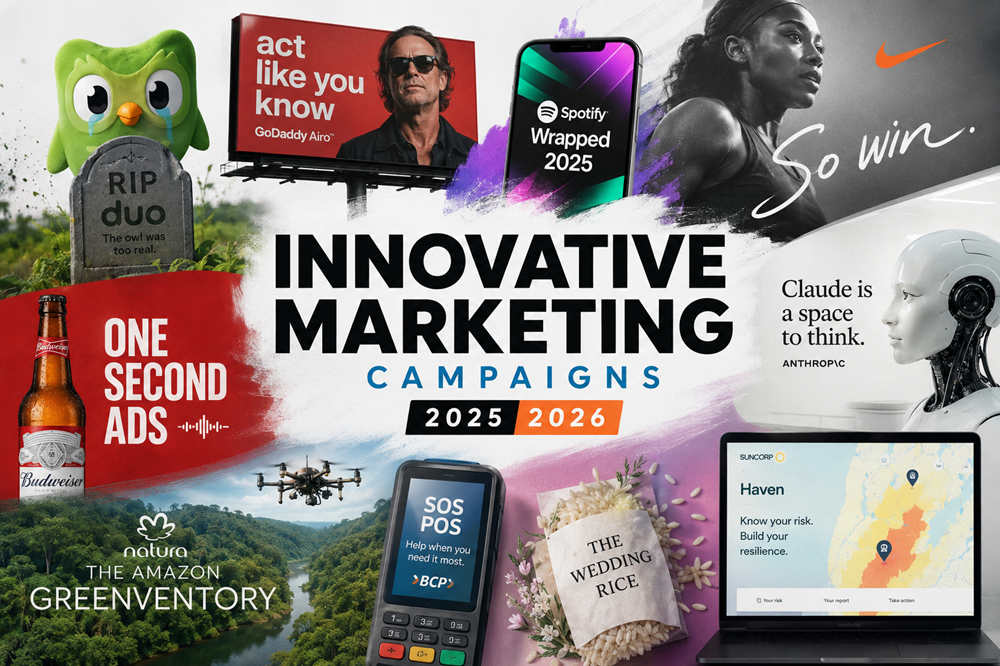
Duolingo began February 2025 by announcing the fictional death of Duo, its green owl mascot. What could have been a brief social media joke developed into a continuing story involving mock investigations, reactions from celebrities and other brands, changes to Duolingo’s social profiles, and a challenge encouraging users to complete lessons to help bring Duo back.
The campaign succeeded as entertainment because Duo already had a recognizable personality. Duolingo had spent years portraying the mascot as an unpredictable character who pressured learners to maintain their streaks. The storyline therefore felt consistent with the brand rather than like an unrelated attempt to attract attention.
Duolingo also demonstrated the importance of local adaptation. The company did not use the death storyline in Japan, where joking about death was considered culturally inappropriate. Duo simply disappeared in that market. This allowed the campaign to retain its central mystery without applying the same joke everywhere.
Rather than publishing isolated posts, Duolingo treated social media as a place for serialized brand storytelling. Followers were not only watching the campaign; they were helping it develop.
2. GoDaddy Airo: “Act Like You Know”
GoDaddy needed to explain how its AI-powered Airo platform could help someone turn an idea into an online business. Instead of presenting a conventional list of features, the company worked with actor Walton Goggins to create a functioning eyewear brand called Walton Goggins Goggle Glasses.
The website, visual identity, product concept, and marketing materials became evidence of what the platform was designed to do. The unusual business also worked as entertainment, giving audiences a reason to remember the demonstration beyond the software itself.
GoDaddy’s campaign addressed a genuine concern among small-business owners: the feeling that they are expected to understand domains, websites, branding, marketing, and ecommerce before they can begin. “Act Like You Know” framed Airo as a tool for handling unfamiliar parts of that process.
The campaign received the 2025 Cannes Lions Creative B2B Grand Prix. Its broader lesson is that a technical product becomes easier to understand when customers can see something real being built with it.
3. Budweiser: “One Second Ads”
Budweiser created a series of advertisements that lasted only one second. Each played the opening note or beat of a recognizable song and challenged music fans to identify it.
The time limit was the central creative idea. It turned an extremely short placement into a test of musical knowledge, encouraged repeat views, and gave fans an easy reason to share their answers. According to the campaign’s One Show case study, the ads generated more than 68 million impressions during their first two weeks and received 119% more views than the campaign benchmark.
The approach also showed how a brand can design around media behavior. Rather than trying to prevent people from skipping an advertisement, Budweiser made the message finish before it could be skipped.
However, the campaign also attracted criticism over music licensing. That controversy is an important reminder that an inventive format does not remove the need to consider permissions, creator compensation, and intellectual-property risk.
4. Natura: “The Amazon Greenventory”
Brazilian cosmetics company Natura combined drones, artificial intelligence, scientific research, and local knowledge to map approximately 400 square kilometers of the Amazon in six months.
The project identified around 30,000 trees with potential cosmetic applications. It also aimed to improve sustainable harvesting methods and give local communities a stronger economic reason to protect the forest rather than clear it.
What made the campaign notable was not the presence of AI by itself. The technology had a defined role within Natura’s sourcing, environmental, and community strategy. It contributed to an operational system rather than serving as a superficial addition to an advertising message.
“The Amazon Greenventory” received the 2025 Sustainable Development Goals Lions Grand Prix. Its credibility came from connecting the campaign to how the company finds ingredients and works with the people living in the region.
5. LG: “Radio Optimism”
LG’s Radio Optimism invited people to write a message to someone they cared about, choose a musical genre and mood, and turn the message into a personalized AI-generated song.
The idea supported LG’s “Life’s Good” positioning while responding to a recognizable tension: digital platforms make frequent communication easy, but those interactions do not always feel meaningful. Rather than publishing advertisements about connection, LG gave people a tool for creating a personal gesture.
The platform was available in six languages and produced more than 700,000 personalized songs. LG reported that the tracks were listened to or shared more than 1.5 million times, while related campaign content generated more than 30 million social engagements and 2.4 billion views.
Radio Optimism was an effective use of AI because the technology served a clear human action. Users were not asked to admire the tool; they were invited to make and send something personal.
6. Spotify: 2025 Wrapped
Spotify Wrapped continued to turn individual listening data into content that users wanted to share. The 2025 edition added further social and group features, including Wrapped Party, while extending the experience through approximately 50 physical fan destinations around the world.
The campaign worked across several layers without losing its central idea. It was a personalized product feature, an identity statement, a social comparison, an artist-promotion system, and a global event.
Spotify reported that the 2025 edition reached more than 300 million engaged users and generated more than 630 million social shares in 56 languages. Those figures illustrate the difference between personalization that merely changes a recommendation and personalization that gives users a story about themselves.
The annual campaign remains distinctive because sharing is a natural part of the experience. Users are not simply reposting a Spotify advertisement; they are publishing a visually recognizable summary of their own listening behavior.
7. Nike: “So Win”
Nike returned to Super Bowl advertising in 2025 with “So Win,” a campaign centered on the double standards applied to women athletes.
The film begins with a series of restrictions women in sport are often expected to accept: they should not be too confident, outspoken, demanding, emotional, or ambitious. It then turns those statements into a challenge to succeed anyway.
The campaign featured athletes including A’ja Wilson, Caitlin Clark, Jordan Chiles, Sabrina Ionescu, Sha’Carri Richardson, and Sophia Wilson, with narration by Doechii. Athlete-focused extensions, photography, and social content carried the message beyond the main television placement.
Nike did not publish detailed campaign-performance figures in its announcement, so the inclusion of “So Win” is based on its clear cultural position and disciplined execution rather than a demonstrated sales result. The campaign stood out by connecting a broad brand message with a specific tension experienced by its featured athletes.
Innovative Marketing Campaigns from 2026
8. Anthropic: “Claude Is a Space to Think”
Anthropic used its 2026 Super Bowl campaign to imagine what conversations with an AI assistant might feel like if product advertisements interrupted the answers.
The films showed people asking ordinary questions and receiving awkward commercial messages in response. The humor turned a product policy into a visible contrast: Anthropic said Claude would remain free of sponsored links, undisclosed product placements, and advertiser influence within its responses.
This was more than a promise of a cleaner interface. Anthropic framed the absence of advertising as part of Claude’s purpose and business model. The company argued that an assistant intended for work and careful thought should not have competing incentives inside the conversation.
The campaign received a 2026 Cannes Lions Film Grand Prix. Detailed acquisition or conversion results were not publicly disclosed, so its significance lies primarily in how clearly it translated an abstract product principle into challenger-brand positioning.
9. Adidas and Willy Chavarria: “Comienza Con El Sueño”
Adidas Originals and designer Willy Chavarria launched “Comienza Con El Sueño,” meaning “It Begins With the Dream,” ahead of the 2026 FIFA World Cup.
Rather than concentrating only on stadiums, trophies, and established stars, the campaign focused on the streets, families, local cultures, and early influences from which sporting ambitions grow. It featured emerging Mexican players alongside a collection informed by Mexican football heritage and Chavarria’s Mexican American perspective.
The campaign’s product, casting, and story shared the same idea. Apparel was not simply placed beside an unrelated cultural message; it carried design references connected to the identity the campaign was exploring.
The launch announcement did not include campaign-performance figures. Its place on this list is therefore based on the distinctiveness and coherence of its cultural storytelling, not on publicly demonstrated commercial results.
10. BCP: “SOS POS”
Peruvian bank BCP turned ordinary point-of-sale terminals into emergency locations where people whose phones had been stolen could begin blocking access to their bank accounts.
The campaign repurposed infrastructure that was already widely available. Victims did not need to install a new app on a device they no longer possessed or wait until they could contact a call center. They could begin protecting their accounts through participating payment terminals.
For a bank, the service communicated security more persuasively than a general promise. It placed a practical safeguard at the moment when customers were most likely to feel vulnerable.
“SOS POS” reached more than 34 million people in Peru and received the 2026 Creative Data Lions Grand Prix. Its innovation came from giving familiar infrastructure a valuable second purpose.
11. Wikifarmer: “The Wedding Rice”
Greek wedding tradition commonly involves throwing rice over newlyweds. Meanwhile, some rice produced by farmers cannot enter the food market because its appearance or size does not meet commercial standards.
Wikifarmer connected the two circumstances. Rice that would otherwise have little or no value was packaged for ceremonial use and sold to wedding planners, creating an additional revenue stream for farmers while reducing the use of edible rice for a non-food purpose.
The campaign did not depend on a new platform, complicated production system, or expensive piece of technology. Its strength came from recognizing that an unwanted agricultural by-product could meet an existing demand.
“The Wedding Rice” received the 2026 Creative Business Transformation Lions Grand Prix. The model was praised for its simplicity, commercial value, and potential to be adapted beyond one market.
12. Suncorp Insurance: “Haven”
Suncorp developed Haven to help Australian homeowners understand how exposed their properties may be to bushfire, flood, cyclone, and storm risks.
The digital experience combines property information, historical weather events, climate research, natural-hazard data, and Suncorp’s own information. Users receive estimated risk levels and a personalized report with practical suggestions for strengthening their homes.
The initiative changed the usual role of insurance marketing. Instead of concentrating only on policies, premiums, or recovery after damage, Haven helped customers consider risk before an event occurred.
Haven received the 2026 Dan Wieden Titanium Lions Grand Prix. It stood out because it turned the insurer’s knowledge into a long-term public service rather than reserving that expertise for claims and promotional messages.
Five Practical Lessons Smaller Brands Can Apply
1. Start with a behavior or problem, not a channel
None of these campaigns began with a generic decision to “make something viral” or “use AI.” They addressed a more precise observation.
Duolingo had an audience familiar with its mascot’s personality. BCP recognized that people who lose their phones also lose their easiest way to contact their bank. LG focused on the gap between frequent digital communication and meaningful personal connection.
Smaller businesses can find similar opportunities by reviewing support requests, customer interviews, search queries, abandoned processes, product reviews, and unofficial ways customers already use their services.
2. Make the central idea easy to explain
The strongest concepts can usually be summarized in one sentence:
- Guess a song from a one-second advertisement.
- Complete lessons to bring a brand mascot back to life.
- Build a real company with the software being advertised.
- Turn an ordinary payment terminal into an emergency banking tool.
- Convert an unwanted crop into a product for wedding ceremonies.
A campaign can use several platforms and formats, but the core mechanism should remain recognizable. Adding more channels does not strengthen an idea that is difficult to understand.
3. Give the audience a meaningful role
Participation should be more substantial than asking people to like, comment, or repost.
Spotify users received personal histories. LG users created songs for people they knew. Budweiser invited fans to solve something. Duolingo allowed lesson activity to become part of the unfolding story.
A smaller company might offer a useful assessment, personalized result, creative tool, public challenge, customer contribution, or interactive demonstration. The action should make sense within the campaign rather than being added only to increase engagement statistics.
4. Let the product or expertise provide proof
GoDaddy demonstrated its platform by using it to build a business. Suncorp made its risk knowledge available through a homeowner tool. BCP used banking infrastructure to help customers protect their accounts.
This approach is particularly valuable for companies selling technical, professional, or unfamiliar services. A limited free tool, sample workflow, calculator, diagnostic, live demonstration, or detailed case example can often communicate more than a broad claim about quality or innovation.
5. Evaluate results and risks separately from creativity
An original campaign is not automatically an effective or responsible one. Marketers should distinguish creative recognition from business outcomes such as qualified leads, product trials, sales, retention, reduced support demand, or changed customer behavior.
They should also review legal, cultural, privacy, accessibility, and reputational risks before launch. Duolingo adapted its storyline for Japan, while the controversy surrounding Budweiser’s use of music showed what can happen when an inventive format raises unresolved rights questions.
The measurement plan should be chosen before production begins. The correct metric depends on the campaign’s purpose, not on which number looks most impressive afterward.
Final Thoughts
The innovative marketing campaigns that shaped 2025 and 2026 did not share one technology, medium, or creative style. Their common strength was a clear connection between the audience, the brand, and the experience being created.
Some made products easier to understand. Others gave existing infrastructure a new purpose, turned customer data into identity-driven content, or created a useful service instead of another promotional message.
Smaller brands do not need to reproduce the scale of these campaigns. The more practical goal is to identify one real audience tension and develop a memorable, useful, and responsible way for people to experience the brand’s value directly.