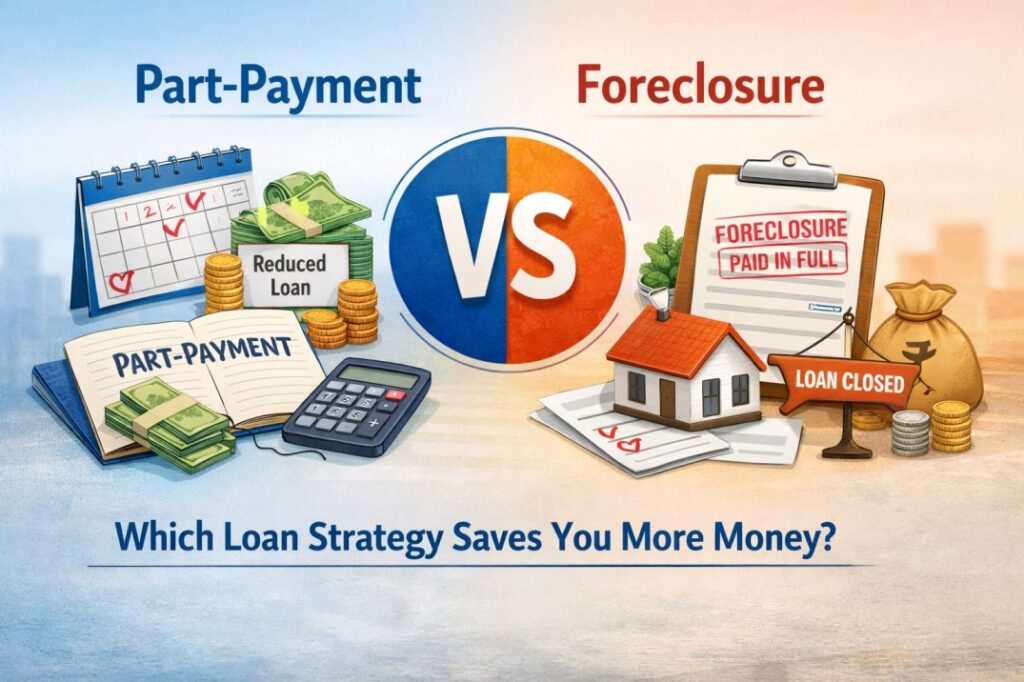
When you come into some extra money while a loan is still running, the instinctive reaction is simple: “Let me close this loan and be done with it.”
While that instinct feels emotionally satisfying, loan decisions rarely reward emotion. They reward understanding, especially when it comes to how interest is calculated.
Two common options come up in this situation: part-payment and foreclosure. They sound similar, but the financial outcomes can be very different depending on timing, penalties, and cash flow.
Let’s break it down calmly and clearly.
What Is Part-Payment?
Part-payment means paying an additional amount over and above your regular EMI, while continuing the loan.
This extra amount goes directly toward reducing the principal, which in turn lowers the interest charged on future EMIs. Depending on your lender’s terms, part-payment can result in:
- A reduced loan tenure
- Lower EMIs
- Or a combination of both
The key advantage of part-payment is flexibility. You reduce interest outgo without fully exhausting your cash reserves.
What Is Loan Foreclosure?
Foreclosure is the complete closure of a loan before its scheduled end date. You pay the outstanding principal along with any applicable charges, and the loan account is closed.
Once foreclosed:
- Interest stops completely
- EMIs end
- The psychological relief of being debt-free kicks in
However, foreclosure isn’t always as straightforward as it sounds. Many loans come with prepayment or foreclosure charges, especially in the early years.
Why Interest Timing Matters More Than the Amount
Loan interest isn’t spread evenly across the loan tenure.
In most long-term loans (especially home loans), the early years are interest-heavy. A large portion of your EMI initially goes toward interest, not principal. This is why actions taken earlier in the loan lifecycle tend to have a much bigger impact.
A part-payment made early can significantly reduce the total interest you pay over the loan’s life. The same amount paid later may barely move the needle.
When Part-Payment Makes More Sense
Part-payment is often the better option when:
- You want to reduce interest but retain liquidity
- Your loan allows part-payments with low or zero penalties
- You’re in the early or mid-stage of a long-term loan
- You want flexibility to handle emergencies or future expenses
For many borrowers, especially home loan holders, disciplined part-payments in the early years can cut several years off the loan tenure without the pressure of closing the loan entirely.
When Foreclosure Is the Better Choice
Foreclosure may make more sense if:
- Foreclosure charges are minimal or nil
- Interest rates on the loan are high
- You have surplus funds and a stable financial cushion
- You want to simplify finances and remove monthly obligations
In such cases, the certainty of zero future interest can outweigh the cost of penalties or the opportunity cost of using a lump sum.
The Often-Ignored Factor: Cash Flow Comfort
Many decisions go wrong not because of incorrect math, but because of cash flow stress.
Using all available savings to foreclose a loan might reduce interest, but it can also:
- Leave you vulnerable to emergencies
- Force future borrowing at higher rates
- Increase financial anxiety
Sometimes, a slower but steadier reduction through part-payment offers a better balance between savings and peace of mind.
There Is No Universal “Right” Answer
Part-payment and foreclosure are tools, not rules.
The right choice depends on:
- Where you are in the loan tenure
- The interest rate
- Applicable penalties
- Your emergency fund and income stability
Before deciding, ask one simple question: Will this decision meaningfully reduce my total interest without hurting my financial flexibility?
If the answer is yes, you’re likely on the right path.
Final Thought
Loans don’t respond to urgency or emotions. They respond to structure and timing.
Understanding how interest works gives you the clarity to choose calmly, whether that means part-paying consistently or closing the loan entirely.
Sometimes, the smartest financial decisions are the quiet ones that don’t feel dramatic at all.

Leave a Reply